Exhibit IV
The Grave and Monument
From a roadside grave to Buttram Memorial Park
Lieutenant Andrew Jackson “Jack” Buttram was killed at Munford on April 23, 1865. His death was not the end of his story.
For more than a century and a half, local residents, descendants, veterans, historical organizations, and the Town of Munford have worked in different ways to remember him and preserve the place where he fell. The grave and monument seen at Buttram Memorial Park today represent several generations of that effort.
The Original Grave Site
Accounts preserved from those who remembered the Battle of Munford placed Buttram’s grave at or very near the place where he was killed. He was buried near the road in what later became the yard of the Munford Methodist Church parsonage.
The location remained recognizable to local residents for decades. Long before a permanent stone was erected, the grave was enclosed by a simple wooden fence and cared for as the resting place of the Confederate officer killed at Munford.
An Effort to Permanently Mark the Grave
By the early twentieth century, concern had grown that Buttram’s grave deserved a permanent memorial.
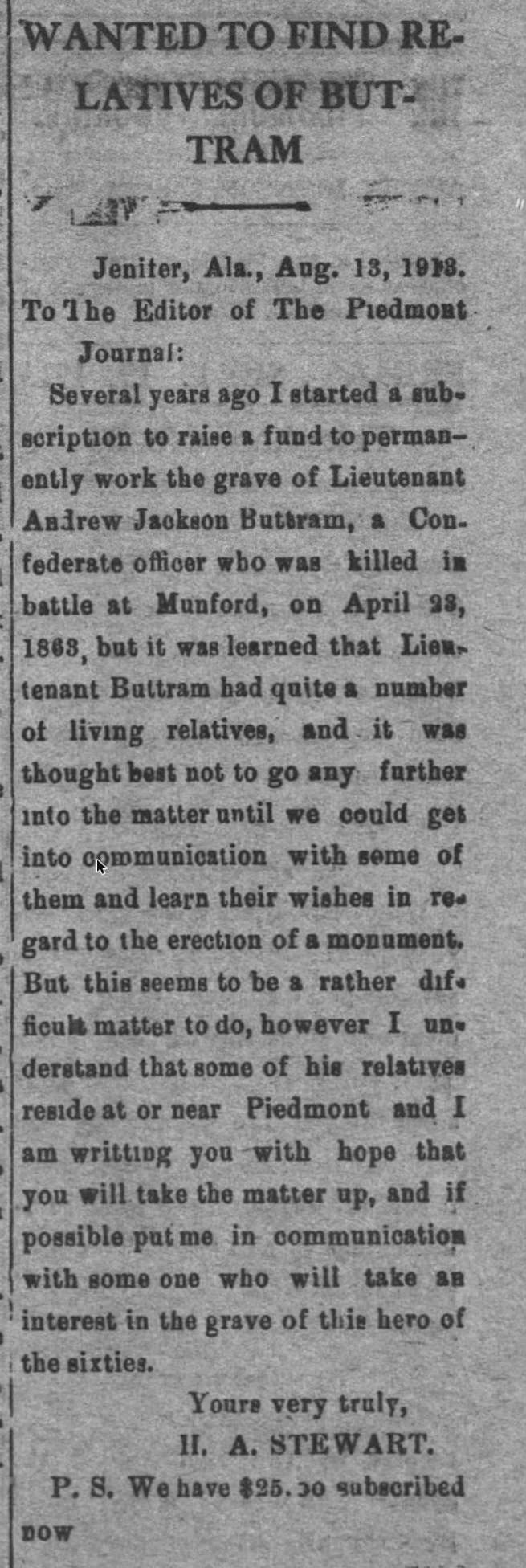
On September 19, 1913, The Piedmont Journal published a letter from H. A. Stewart of Jenifer, Alabama. Stewart explained that he had begun raising money several years earlier to permanently mark Buttram’s grave. Before proceeding, however, he wanted to locate members of the Buttram family and learn their wishes concerning the proposed monument.
At the time his letter was written, Stewart reported that $25.50 had already been subscribed toward the effort.
The Grave Before the Monument
Only weeks later, Buttram’s grave received much wider attention.
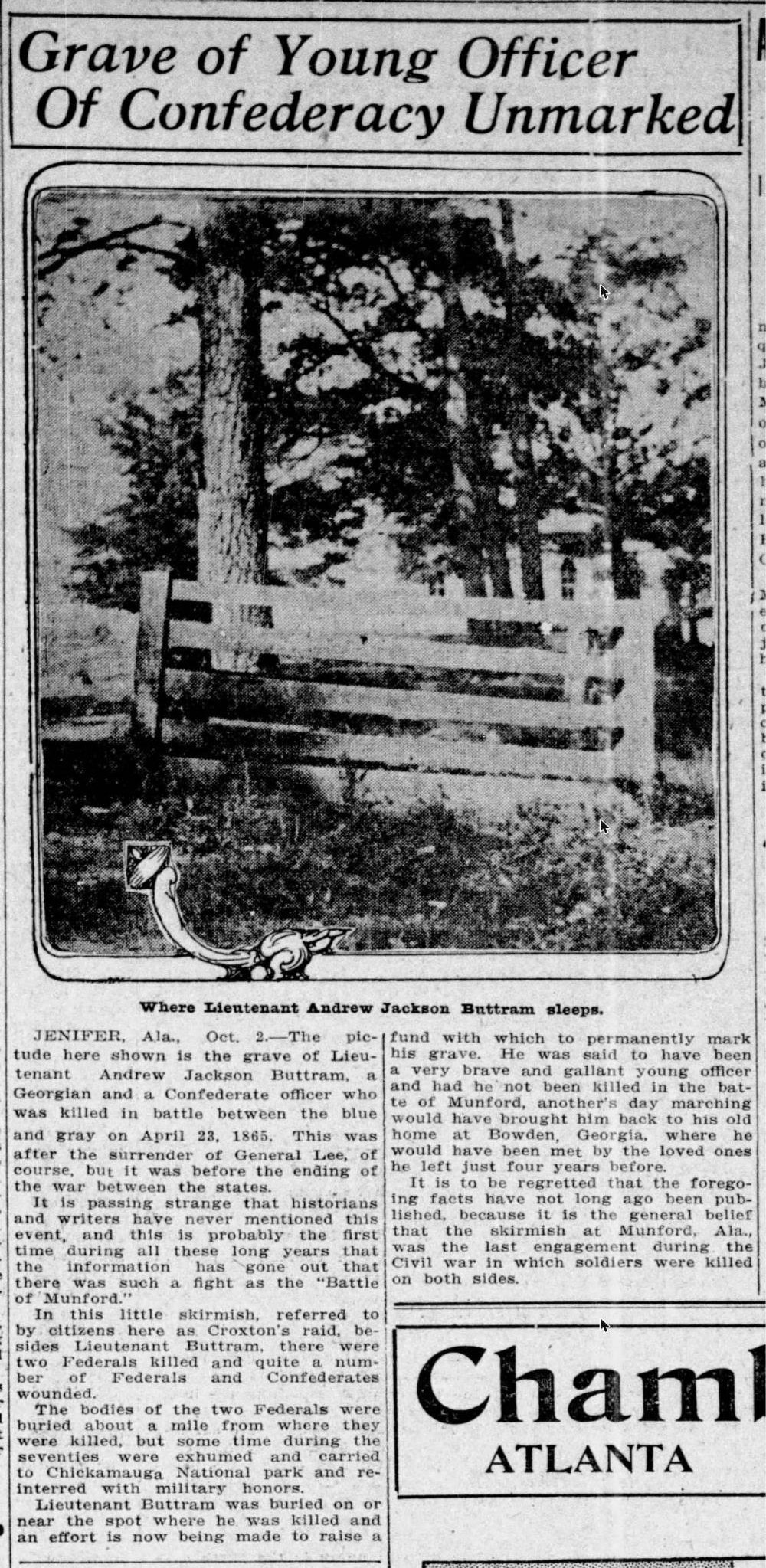
On October 2, 1913, The Atlanta Journal published an article titled “Grave of Young Officer of Confederacy Unmarked.” The article included a photograph of the grave and identified it as the place where Lieutenant Andrew Jackson Buttram rested.
The photograph is especially important because it shows the grave before the marble monument was erected. A wooden enclosure surrounds the burial place beneath the trees. The newspaper reported that an effort was then underway to raise money for a permanent marker.
The Monument Is Unveiled
The effort to permanently memorialize Buttram was completed the following year.
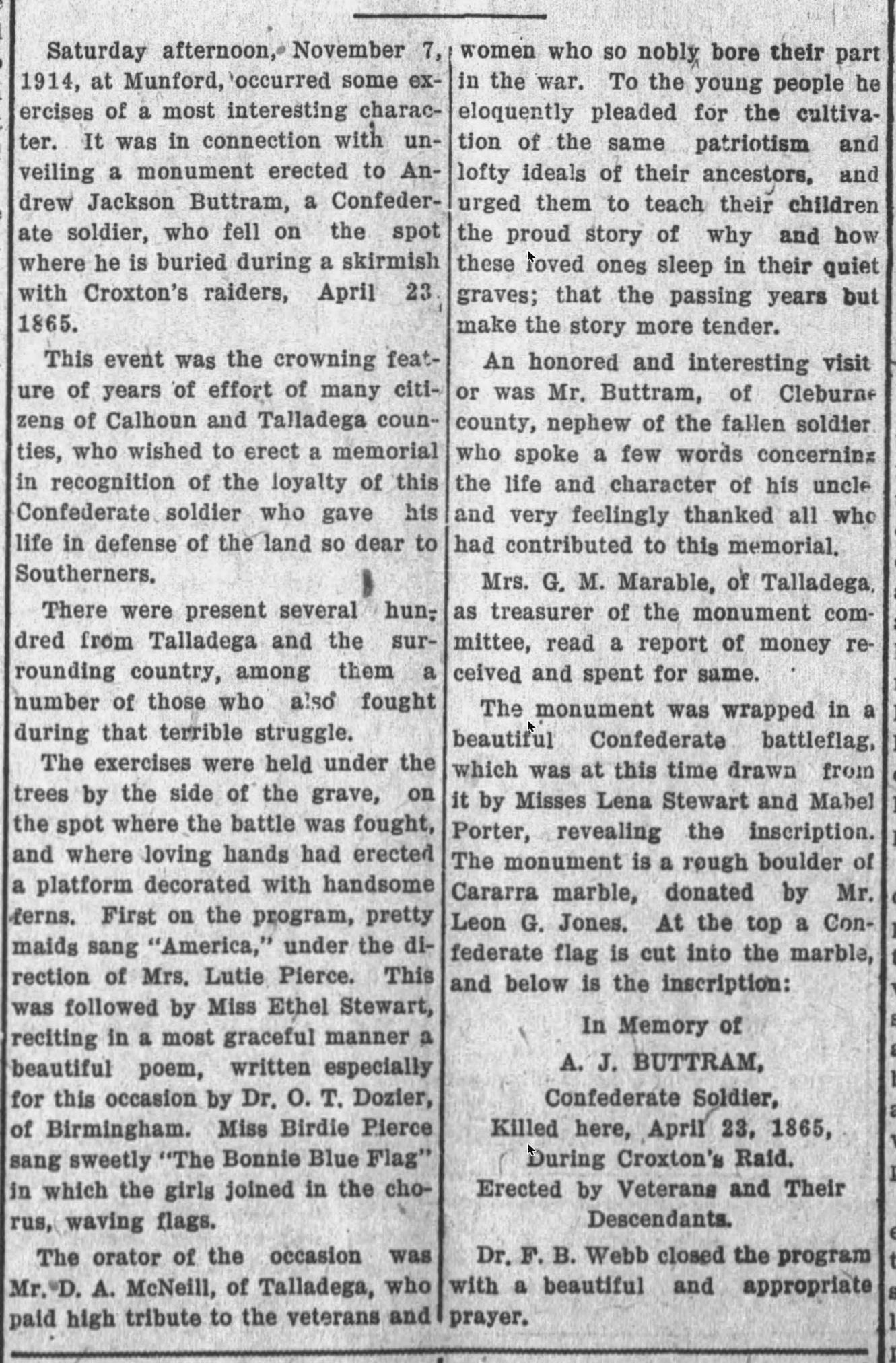
On Saturday afternoon, November 7, 1914, several hundred people from Talladega and the surrounding area gathered beside the grave for the unveiling of a monument to Andrew Jackson Buttram.
Our Mountain Home described the ceremony as the culmination of years of work by citizens of Calhoun and Talladega Counties. The exercises were held beneath the trees beside the grave, on the ground where the fighting at Munford had taken place.
The program included music, prayer, remarks honoring Confederate veterans, and a poem written especially for the occasion by Dr. O. T. Dozier of Birmingham. Mr. D. A. McNeill of Talladega delivered the principal address.
One of Buttram’s nephews, Mr. D. Buttram of Cleburne County, attended the ceremony and spoke about his uncle. Mrs. G. M. Marable of Talladega, treasurer of the monument committee, presented a report on the funds received and spent for the memorial.
The monument had been wrapped in a Confederate battle flag. Misses Lena Stewart and Mabel Porter removed the covering and revealed the stone to those assembled.
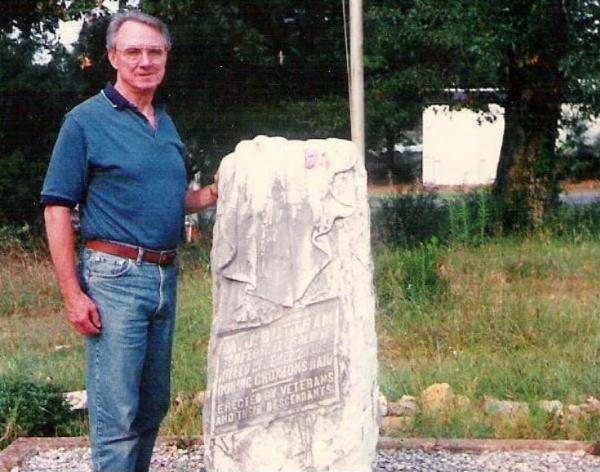
The newspaper described the monument as a rough boulder of Carrara marble, donated by Leon G. Jones, with a Confederate flag carved near the top.
Its inscription reads:
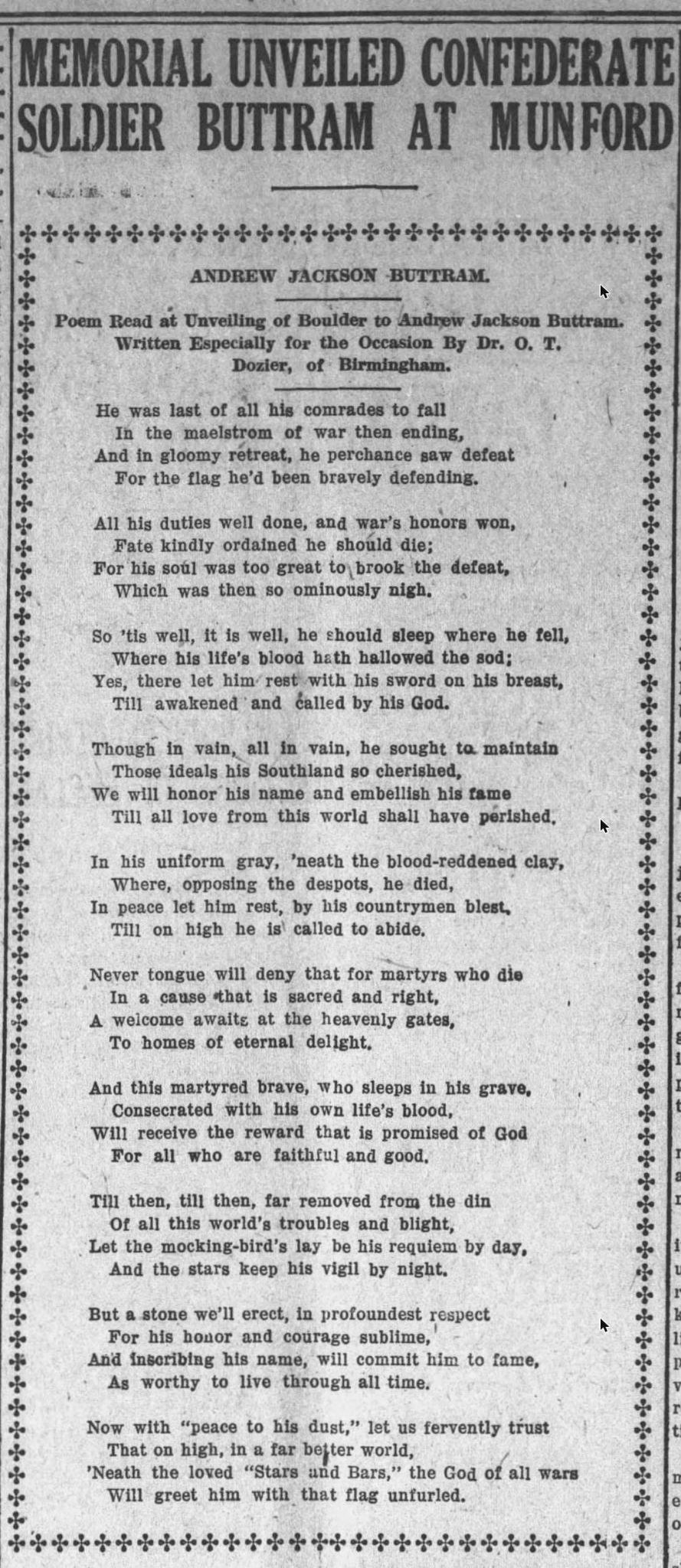
The dedication also included a poem written especially for the unveiling by Birmingham physician Dr. O. T. Dozier.
The poem, titled “Andrew Jackson Buttram,” reflected how those who erected the monument understood both Buttram’s death and their responsibility to preserve his memory. The complete poem was printed alongside the newspaper’s account of the ceremony.
Remembered for Generations
The unveiling did not end local interest in Buttram or the events at Munford.
During the following decades, newspapers repeatedly returned to the story of the battle, Buttram’s death, and his grave. Accounts appeared in Our Mountain Home and other newspapers in 1923, 1924, 1928, and 1932.
Some of these articles preserved the recollections of people who had witnessed or remembered the events surrounding the Battle of Munford. Others debated Munford’s place among the final engagements of the Civil War.
Together, they show that Buttram’s grave had become more than a burial place. It had become a local historical landmark and a physical connection between the people of Munford and the events of April 1865.

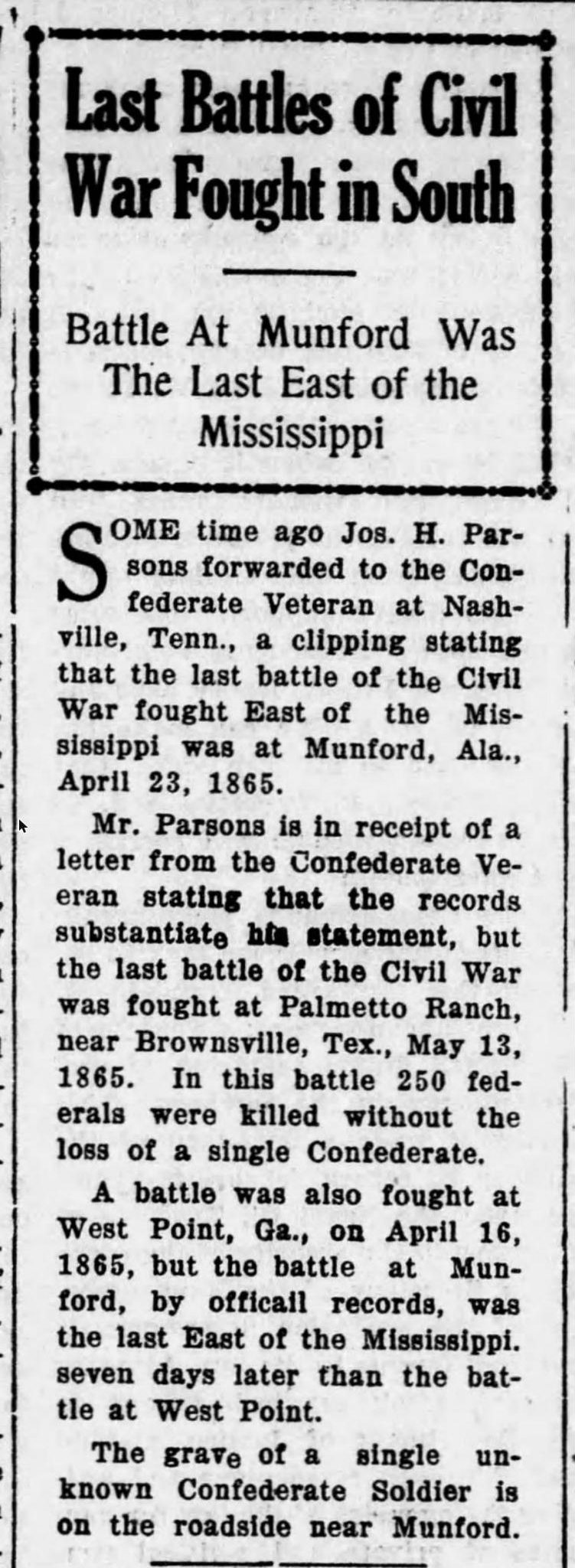
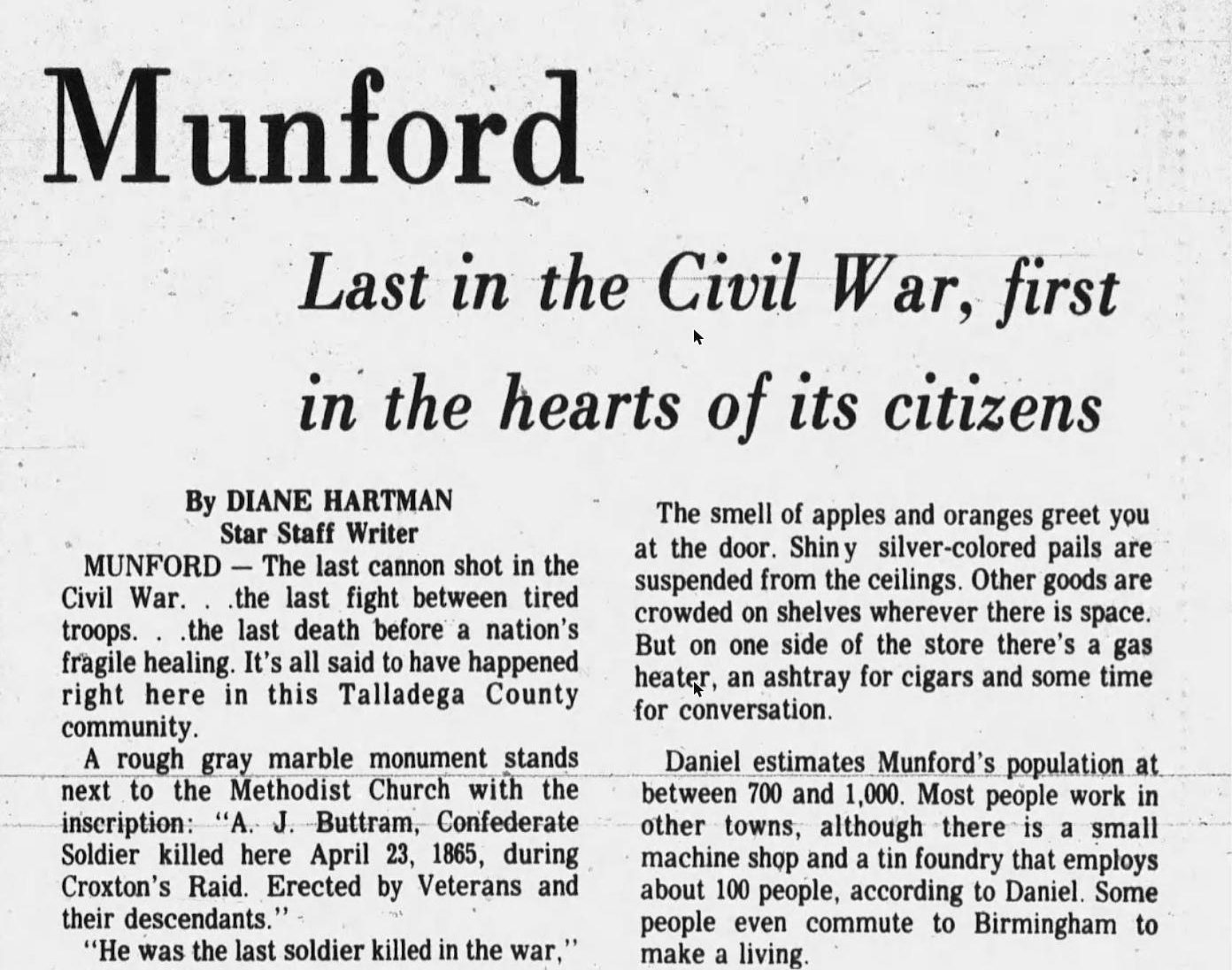
Newspaper accounts published during the 1920s and 1930s continued to preserve the story of the Battle of Munford, the death of Lieutenant Buttram, and the grave that marked the site.
The Monument Is Moved
For much of the twentieth century, the grave remained close to the roadway near the Methodist church property.
Later recollections state that the grave and monument were once surrounded by a small wall or railing. As the area changed and automobile traffic increased, the location became increasingly vulnerable.
The original monument was eventually moved away from the grave. After another placement near the church created the possibility of accidental damage from vehicles, it was moved across the road to the triangular property where Buttram Memorial Park is located today.
For a period of years, the historic monument and Buttram’s actual burial place therefore stood in separate locations.